
You don’t have to walk into a gallery to experience art in Prescott.
It’s on the sides of buildings. It’s beneath your feet. It wraps around the library, fills unexpected walls and alleyways, commemorates people we’ve lost, celebrates the West, and occasionally makes you stop your car because you suddenly notice something you’ve driven past dozens of times.
Taken together, Prescott’s murals and public artwork create something of an outdoor history book.
And unlike a history book, this one keeps changing.
Before the Murals Came the Monuments
Prescott’s current mural movement is relatively young. According to Sharlot Hall Museum, the city’s urban mural history stretches back only about three decades. But public art was part of Prescott long before artists began transforming blank walls.
One of the most recognizable examples stands on Courthouse Plaza.
The Rough Rider monument was unveiled in 1907, honoring the Arizona volunteers who served with the Rough Riders during the Spanish-American War. The figure is generally associated with Captain William “Buckey” O’Neill, Prescott’s former mayor and one of the city’s best-known historical figures.
More than 80 years later, another bronze would connect public art with another piece of Prescott identity. Richard Terry’s “Early Rodeo” was commissioned by the Prescott Community Art Trust to commemorate 100 years of rodeo in 1988.
The subjects tell us something about how Prescott once used public art: primarily to commemorate history, heroes and Western heritage.
Today, the definition has become much broader.
History Under Your Feet
Some of Prescott’s most unusual public artwork isn’t hanging on a wall at all.
It’s in the sidewalk.
Artist Frances “Fran” Wildman created historical timelines that were literally inscribed into concrete. A Yavapai County timeline was created near the Courthouse in the 1980s, while Wildman’s World History Timeline became part of the Prescott Public Library. The library timeline was later restored and repainted by the Mural Mice during the library’s 2006 renovation and expansion.
Thousands of people have probably walked across these works without realizing they’re standing on public art.
That’s part of the fun of exploring Prescott this way: some of its art hides in plain sight.
Then Prescott’s Walls Started Talking
Prescott’s oldest surviving mural is believed to be the artwork on the Salvation Army building at 231 S. Montezuma Street, painted by Bonnie Casey and Mike Shepard sometime in the 1990s.
Interestingly, Prescott doesn’t have the collection of surviving vintage advertising murals seen in some historic American downtowns. According to Sharlot Hall Museum’s research, old painted advertisements for brands such as Coca-Cola, tobacco or household products either disappeared or the buildings carrying them did.
That means Prescott’s surviving murals aren’t primarily old advertisements uncovered during restoration.
They’re intentional pieces of art.
And around the turn of the 21st century, they began multiplying.
The Mural Mice Arrive
One name appears repeatedly when you start exploring Prescott’s murals: The Mural Mice.
The group helped create some of the city’s most ambitious public artwork, including Granite Creek Watershed in 2001, Art for All in 2007, Mile High and Climbing in 2008, Beyond Words in 2009 and Music of Nature in 2010.
One of the standouts is Art for All, located at 109½ S. Granite Street.
The enormous mural wraps around the downtown parking garage and turns what could have been an ordinary concrete surface into a colorful celebration of Prescott’s artistic history.
It’s a perfect example of what public art can do: take infrastructure designed to be overlooked and turn it into a destination.
Then there’s Beyond Words, created in 2009 around the Prescott Public Library. Local artist Dana Cohn worked with the Mural Mice on the project, further connecting Prescott’s public art with community spaces.
When a Mural Started a Conversation
Another Mural Mice project became one of the most talked-about—and controversial—pieces of public art in Prescott’s recent history.
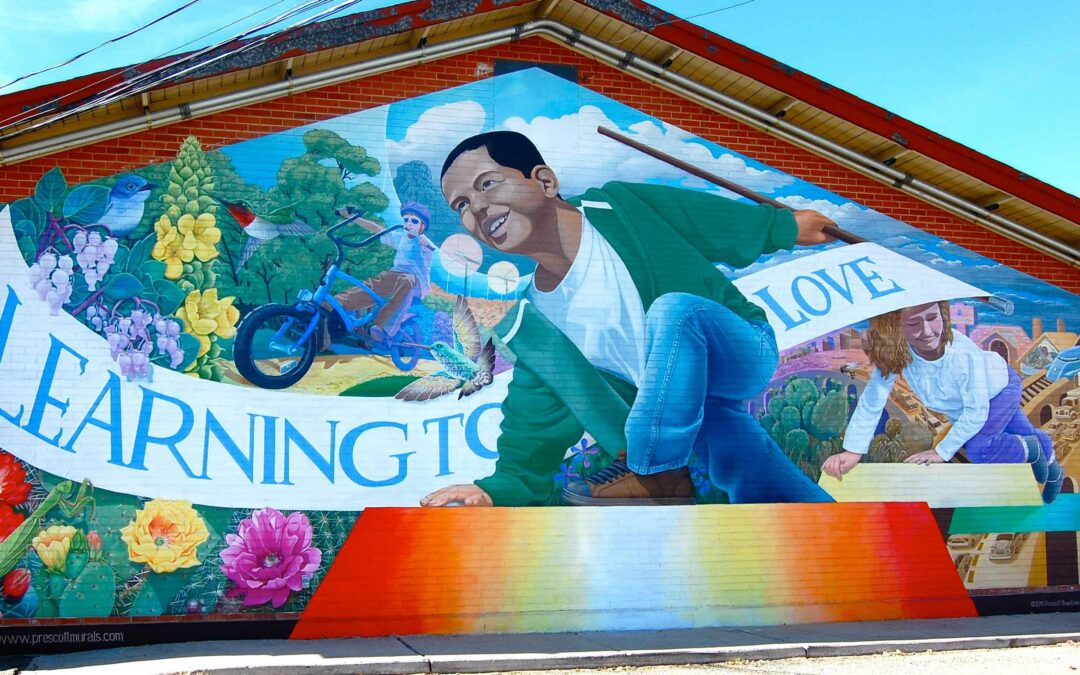
In 2010, the Mural Mice worked with students and community members to create Go on Green at Miller Valley Elementary School. The colorful mural promoted walking, bicycling and environmentally friendly transportation and featured portraits based on children who actually attended the school.
But while the mural was being painted, the artists reported that racial slurs were shouted from passing vehicles. The artwork also drew public criticism, including comments from then-Prescott City Councilman and radio host Steve Blair questioning its emphasis on diversity.
The controversy intensified when school officials asked the artists to lighten the face of a Hispanic student who was prominently depicted in the mural. School officials said the concern involved the darkness of the shading and how the portrait appeared from a distance, while the artists objected to changing the child’s appearance.
The request quickly drew national attention and significant local backlash.
More than 300 people gathered at the school in support of the mural, and the school district ultimately reversed the decision. Superintendent Kevin Kapp publicly apologized, and the artists were allowed to restore the mural according to its original artistic intent.
The episode became about much more than paint on a school wall.
It raised questions about representation, race, public art and who gets to see themselves reflected in the community around them.
Today, the Miller Valley mural is an important part of Prescott’s public-art history for both the artwork itself and the conversation that surrounded it.
Public art can beautify a wall.
Sometimes, it can also reveal something about the community looking back at it.
Prescott Gets Its Own Postcard
Sometimes public art doesn’t need to commemorate a person or explain history.
Sometimes it simply says: this is us.
Melanie Link’s Prescott Arizona mural at 150 S. Montezuma Street was created in 2015 and has become one of the city’s recognizable photo spots.
Another piece, Prescott Letters, was created by Juliana Hutchins and Dana Cohn in 2019 at 209 W. Gurley Street.
These pieces represent something different from Prescott’s traditional monuments. They’re interactive in an informal way. People stand in front of them, photograph themselves with them and share them.
Public art becomes part of how residents and visitors visually identify the city.
Cowboys, Trains and the Prescott Story
Of course, Prescott hasn’t abandoned its Western roots.
Quite the opposite.
Murals throughout town revisit the imagery that shaped the community.
First Train to Prescott, created by Juliana Hutchins in 2014 at 721 Miller Valley Road, recalls the arrival of the railroad.
And cowboy imagery remains unmistakably Prescott.
Rodeo-themed public art proudly declares Prescott’s association with the World’s Oldest Rodeo, placing another piece of the city’s Western identity directly into the streetscape.
These murals do more than decorate buildings. They take stories that might otherwise live inside museums and put them where everyone can encounter them.
Public Art Becomes Remembrance
Some of Prescott’s most powerful newer public art asks viewers not simply to look—but to remember.
The Granite Mountain Hotshots mural, created by Katie Von Kral in 2023, is located at 117 W. Goodwin Street and commemorates the 19 firefighters lost in the Yarnell Hill Fire in 2013.
The city’s remembrance of the Hotshots also demonstrates how murals and sculpture now work together.
On June 30, 2024, a new sculpture honoring the 19 firefighters was dedicated on the Cortez Street side of Courthouse Plaza.
Compare that with the Rough Rider monument unveiled in 1907.
More than a century separates them.
Yet both use art in essentially the same way: to make memory physically present in the center of the community.
“We Are Still Here”
One of the most important additions to Prescott’s contemporary public-art story is We Are Still Here, created by artist Dustin Lopez in 2022 at 147 N. Arizona Avenue, home of the Museum of Indigenous People.
Even its title carries significance.
Prescott’s public art historically leaned heavily toward territorial, cowboy and pioneer narratives. Contemporary works create opportunities to broaden that visual history and acknowledge that the story of this place did not begin with Arizona Territory.
Public art can preserve history.
It can also challenge us to consider whose history has been visible—and whose hasn’t.
A Creek Becomes a Canvas
Then there is the Granite Creek Trail mural, created by Dana Cohn in 2023 at 302 W. Gurley Street.
Sharlot Hall Museum points to it as a local example of trompe-l’œil, an artistic technique designed to fool the eye by creating the illusion of three-dimensional space on a flat surface.
It’s an especially appropriate evolution for Prescott public art.
The earlier murals often told historical stories.
Newer murals can do that while also transforming the physical experience of a place.
A wall doesn’t necessarily have to look like a wall anymore.
Prescott’s Outdoor Gallery Keeps Growing
The city’s official tourism site now identifies at least 17 murals around Prescott, dating from the Salvation Army mural of the 1990s through works created as recently as 2023. Among them are Granite Creek Watershed, Art for All, Mile High and Climbing, Beyond Words, Music of Nature, Share the Road, Prescott Heroes, First Train to Prescott, Prescott Arizona, Teddy Roosevelt, Prescott Letters, We Are Still Here, Granite Creek Trail, Granite Mountain Hotshots and others.
And that’s only the murals.
Add sculptures, memorials, sidewalk artwork and other installations and suddenly Prescott begins to look like one enormous outdoor gallery.
That’s what makes the past-and-present comparison so interesting.
In 1907, public art meant erecting a monumental bronze to permanently memorialize history.
Today it might be bronze.
Or paint.
Or concrete.
Or a community wall.
Or a mural created with schoolchildren that unexpectedly becomes part of a national conversation.
Or an Indigenous artist saying, We Are Still Here.
The medium changes.
The purpose remains remarkably similar.
We’re leaving pieces of ourselves behind.
Take the Prescott Public Art Walk
This could become one of the most fun ways to rediscover your own hometown.
Start around Courthouse Plaza with the Rough Rider monument and Hotshots memorial. Walk the surrounding downtown streets looking for murals. Find Art for All. Look for Prescott Letters. Stop at Prescott Arizona. Head toward the library for Beyond Words and Fran Wildman’s timeline. Continue toward Granite Creek.
And don’t just photograph the artwork.
Look at the dates.
Look at the artists.
Look at what each generation chose to put in public view.
And remember that the stories aren’t always simple. Some pieces commemorate heroes. Others celebrate where we live. Some make us smile. Others, like the Miller Valley mural, remind us that art can spark difficult conversations about who we are and how we see one another.
Together, those works tell a surprisingly detailed story of Prescott: cowboys and firefighters, Indigenous people and artists, schoolchildren and community members, trains and trails, history and nature, remembrance and reinvention.
Prescott’s walls have something to say.
We just have to stop long enough to look.


