
Arizona Adaptive Water Sports provides opportunities for fear-conquering fun for athletes with disabilities and their families
By Hilary Dartt
One of the definitions for recreation is “refreshment of strength and spirits.” Through the outdoor adventure of watersports for adapted athletes and their families, that’s exactly what Arizona Adaptive Water Sports (AAWS) provides for people with disabilities—and their families.
Jo Crawford, AAWS Founder and Chief Visionary Officer, said during a recent interview that through the organization, she strives to empower athletes; not just to try watersports, but to conquer fear and take charge of their own health and lives.
“To watch these kids starting outdoor adventure and having them do this stuff that takes a lot of courage,” she said. “What happens to them later on in life is that they say, ‘Don’t tell me I can’t do something.’”
She wants people to know that “fear is a liar.”
By the time Jo was 18, she had two friends with traumatic brain injuries, and one with a spinal cord injury. She decided to volunteer at St. Joseph’s Hospital, where she eventually became a recreation therapist at the Barrow Neurological Institute/ St. Joseph’s Hospital and Medical Center. At that time—30 years ago—Arizonans with spinal cord injuries were flying to California for a Day on the Bay program, where they participated in adaptive water sports.
Jo remembers thinking, “That’s ridiculous. Why is our population flying to another state to get their needs met?”
With the help of the community, she started the Barrow Day on the Lake program, taking folks out on the water at Bartlett Lake. After 25 years, she retired and in 2018 launched AAWS. Since then, it’s become a statewide program, partnering with dozens of other organizations to bring adapted recreation to hundreds of people with disabilities (for a full list, see AAWS Details, page XX).
Often, once people hear about AAWS, it takes a while for them to actually come out. When they do, it’s life-changing for each athlete, and for the family members, too, as it’s an opportunity for families to have fun and play together.
Jo shared the story of one young lady whose “eyes were as big as silver dollars” as she anticipated her first time kayaking. She enjoyed it so much, she wanted to try waterskiing. She had to get in the water and pass the safety test before she could ski, but after she did, her mom was in tears.
“She said, ‘My kid can do that. She will never be the same again!’” Jo said. “Now [at age 13 or 14] she does competitive adapted snow skiing and she uses her power wheelchair to show her steer.”
This “ripple effect” occurs for athlete after athlete, and family after family.
Conquering fear is about true quality of life.
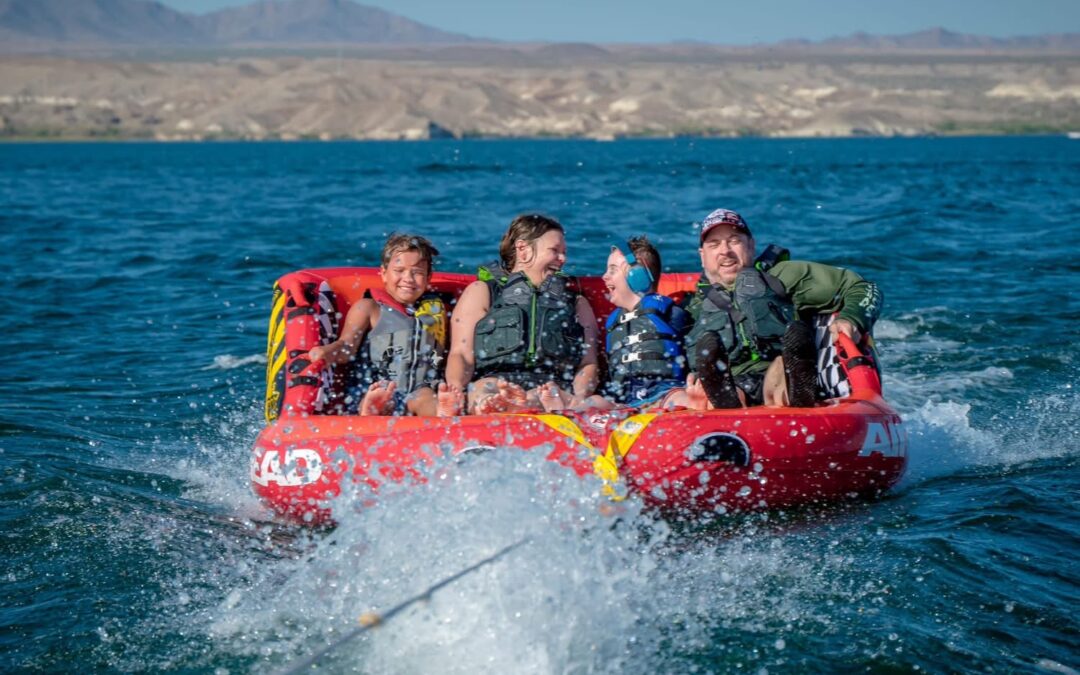
At AAWS, that’s a big job; one that requires dozens of dedicated volunteers and lots of expensive equipment. Athletes pay a very small fraction of the cost to join an AAWS event with its seven adapted activities-waterskiing, wakeboarding, wakesurfing, kayaking, fishing, boating and tubing. The actual cost for the organization is $1,500 per person per day. AAWS relies heavily on volunteers and donors. It takes 12 – 14 people to get one person waterskiing.
Liam Wylie, aged 10, has participated in AAWS programs since he was five. His mom, Stacie, joined him for this first day on the water. “We both had the best day ever,” she said. “I’d just never had a day like that. It was so magical. It truly was this magical day on the lake, seeing his confidence and the thrill he had on the lake.”
Liam has Down Syndrome and is on the autism spectrum, and when it comes to trying new things, Stacie said, “the fun has to outweigh the sensory overload.”
While lake days present different sensory factors for Liam to work through, such as cold water, loud motors, and lots of splashing, “because it’s so fun, it’s worth it.”
Even better, “It gives him the courage to try other things.”
Liam’s dad, David, sent Stacie and Liam off on the first lake day on their own, and later admitted he hadn’t wanted his own anxiety to take away from the potential fun. But after he saw the photos and videos of Liam’s adventures, he was all in.
Everyone who works for AAWS, Stacie said, “is so well versed, so strong. They’re passionate about this. They want people to have this same experience no matter where they’re at.”
Kim Kolstad, who was born with arthrogryposis multiplex congenita (AMC, which affects her muscles and joints), didn’t learn about adapted sports until she was in her early 40s. She tried kayaking and snow skiing before she learned about AAWS—and that experience has been life changing.
In a video on the AAWS website, Kim said adapted sports have changed her life in more ways than one. “I’m in my wheelchair all the time and I love these adventure sports and now I get to participate in them. A year and a half ago, I couldn’t. I was always pretty much just watching from the sidelines.”
Now, she’s in the mix. “I haven’t laughed that hard in so long,” she said of her first time water skiing. “Probably ever, before then. It was just so much fun.”
After seated skiing with outriggers, she tried slalom skiing, water tubing, and wake surfing. The folks at AAWS “encouraged me to try anything and everything I wanted to. They’re all about what you can do and excel at.”
After Kim had gone out a couple of times, Jo told her, “You’re an athlete now. You’re going to have to get your own surfboard.”
“That’s the first time I’ve ever been referred to as an athlete,” Kim said. “And I liked it.”
When asked how the adapted sports experience has trickled over into other parts of her life, Kim laughed. “It hasn’t trickled over. It has flooded over.”
Because of how much she’s loved adapted sports, she ended up moving to Utah, where she works with patients with spinal cord injuries and introduces them to adapted sports. “We get people out on water, on bikes while they’re still in-patient and recovering from injuries.”
“Not only am I able to do [sports] myself, but I’m also able to introduce it to others and show them early in their recovery that they can still be part of life, enjoy the outdoors, and do the things they enjoy, just in a different way.”
Every time she tried a new adapted sport, Kim said, she felt uncertain about how it would go. She said, “I went scared, but I did it anyway.”
The experience of overcoming her fear has spread throughout her life.
Sylvia Baize, whose son Alex has spina bifida, had never heard of opportunities like AAWS until she ran into Jo and her two sons in Kohl’s.
“When her sons told us about [AAWS], it was like, ‘Wow, this is so amazing.’” Not only did someone care enough to approach Sylvia and Alex in the store, but someone had created something fun for people with disabilities.
Although Sylvia said she’s always nervous with something new, and Alex is very introverted and prefers one-on-one interactions to group settings, he had a great time at his first AAWS event. He rode on the boat and went fishing. The following year, he expanded his horizons and eventually tried seated waterskiing, tubing, and the jet ski.
“It’s super important,” she said. “Just being in a setting where you’re ‘normal’ in a wheelchair. It doesn’t make you feel weird or different—you’re just part of the group because everybody has some disability and everybody’s happy and having fun. It feels like such a boost to someone like Alex, who most of the time, when we go shopping, is the guy down low in a wheelchair. So that really makes a difference.”
Jo said that when she started AAWS seven years ago, she prayed it would go statewide. Not only has it done that, but the organization has become part of a network of similar organizations, helping thousands of people improve their health and well-being.
She said that 20 percent of a person’s health is related to what happens in the doctor’s office, and the other 80 is related to what happens in the community. “How can you be healthy if you don’t have access to sports, recreation, and fitness? And that’s where we come in. We provide adapted equipment, portable wheelchair accessible sidewalks, boats and trained volunteers. We break barriers and refresh souls!”
That’s why, as AAWS continues to grow, she said, “I really am in awe about what God has done for this organization.”
AAWS Details
AAWS started offering its programs at Bartlett Lake Marina, thanks to generous support of the owners, Bryan and Eric Church. Bryan has a spinal cord injury and the entire marina is accessible including hoyer lifts to get people from their wheelchairs in and out of the water and on/off the tube.
Now, AAWS offers recreation opportunities at the following lakes:
Bartlett Lake, Lake Powell, Lake Havasu, Lake Pleasant, Watson Lake, Lynx Lake, Kaibab Lake, Willow Springs Lake (in Payson), and Saguaro Lake.
AAWS is family inclusive and has served the following numbers of athletes:
Family-inclusive sports
- Boating: 780
- Kayaking (adapted and standard): 343
- Tubing: 256
- Fishing: 80
Adapted-athlete-only programs (families observe from boats):
- Waterskiing (seated and standing): 114
- Wakesurfing (seated, standing, and prone): 125
- Wakeboarding: 64
AAWS supports with the following nonprofits:
- Arizona, California, and Utah Burn Foundations
- ALS of Arizona
- Brain Injury Association
- Veterans
- Make a Wish Foundation
- Treasure house
- First place
- Arizona Spinal Cord Injury Association
- Arizona Center for the Blind and Visually Impaired
- Foundation for the Blind
- Mile Markers and New Horizons (Lake Havasu)
- Page Unified School District and Helping Hands (Lake Powell)
- Yavapai County school districts (through the Youth Adapted Kayaking Adventure Program)
- Spina Bifida Association of Arizona
- Operation Wakesurf
- Wake for Warriors
- Wake the World
- Arizona Autism United